
What next after the Examination in Public (EIP).

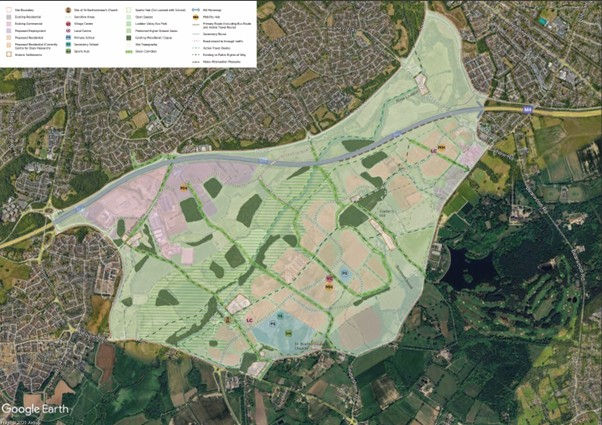
The Inspectors will consider the material they gathered at the first stage of the EIP and should arrive at an initial decision regarding the “soundness” of the plan around early 2026. At this point the inspectors will decide whether to move on to the stage 2 hearings on the plan or that major modifications are required, in which case the ball will be back in the court of WBC. Meanwhile we have two of the three developers for the Loddon Garden Village site putting in planning applications, with the third expected in the spring of 2026.
The first application is the largest, for 2,800 houses on land owned by the University of Reading. Application reference 252498, the consultation ends on 16th January 2026. A summary of the university planning application can be found here Microsoft Word - NTS - UoR, Loddon Garden Village
The second application is from Gleeson and is for 430 houses, application reference 252769. This is primarily on land to the west of the site near Church Lane, Arborfield. This also closes on 16th January.
The third application will be from Hatch Farm developments and will be for the remaining 700 houses to take the total to 3,930 and will be at the eastern end of the site towards Mill Lane, Winnersh.
Clearly the Inspectors will be arriving at their own conclusions as to how “sound” this plan is, we did our best to make clear our concerns, and it felt like they were genuinely keen to get to the nub of the issues. They asked a lot of questions and listened very carefully to the answers they were given. Whilst we await the next stage of the examination, SOLVE Hall Farm suggest we can ALL comment on the submitted planning applications.
For these comments to have any bearing on the outcome they need to be based on current planning regulations. Focus on material planning considerations: These are planning-related issues such as design, layout, parking, traffic, noise, and impact on local character or the environment.
Include your details: Your comments must include your name and address to be considered.
Be specific: Clearly state your reasons and back them up with facts and reasoned arguments. Avoid vague statements.
Avoid non-material considerations: Do not include issues like loss of private view, devaluation of property, or commercial competition, as these are not valid reasons for objection.
For example, Best and Most Valued agricultural land (BMV land) is probably part of the site. It seems no one has done a survey and Wokingham do not know how much BMV land they might be building on.
Protected status: BMV land is given special protection in the planning system to ensure it is prioritized for food production. Therefore, the site should be surveyed to ascertain the BMV grade before being built on.
Sewage was another area WBC struggled with. We know Thames Water are proposing to upgrade Arborfield Water Treatment works but we also know it regularly pumps raw sewage into Barkham Brook. Thames Water are in dire financial straits and may need to be bailed out. The Environment Agency has stated that it has not received any reassurance from Thames Water as regards the upgrade of sewage capacity in the area.
The Traffic Assessment suggests congestion will be made considerably worse by this development. The mitigation measures will not be in place for many years and will rely on very expensive infrastructure delivery. Behavioural change, say from cars to buses, is overly optimistic, as is the degree to which journeys will be internalised. Barkham Parish Council questioned the accuracy of the data used, quoting their own data using their own test equipment as being significantly higher than the figures quoted by WBC. Will “priority measures” for buses be sufficient to get people to use them?
There are many questions regarding financial viability, particularly as this viability is driven by sales values. Given the current economic climate and the fact that the Arborfield Green development is still many years from completion, can the Loddon Garden Village site achieve its house sale targets and therefore finance the infrastructure costs of more than £400m or more than £100,000 per house?
The inspectors were clearly interested in the proposed nil rate of Community Infrastructure Levy (CIL) for the site, which would require a change in WBC policy. Such a policy change requires consultation. How will the demands of the wider community be met without this money?
A&NPC challenged the mineral extraction plans for the site, highlighting that extraction required subsequent infill as well and there was no apparent timetable for this.
The ruined church of St Bartholomew’s was discussed in respect of concerns from Historic England that the site will be surrounded by houses. The valued local heritage “avenue of trees” will be bisected by the proposed new spine road at the Observer Way end of the site. At the other end towards Hatch Farm Way, although the developers denied it cuts through SANG (Sustainable Alternative Natural Greenspace) we believe there is evidence the land it cuts through is designated as “Country Park”.
There may be other points you have thought of that we have omitted from the points listed above, if so please share them with us and others through the comments section. The more of us who take the time to make an objection the more the politicians and developers will need to take heed.
Save Our Loddon Valley Environment at Hall Farm. (SOLVE Hall Farm).


Comments